
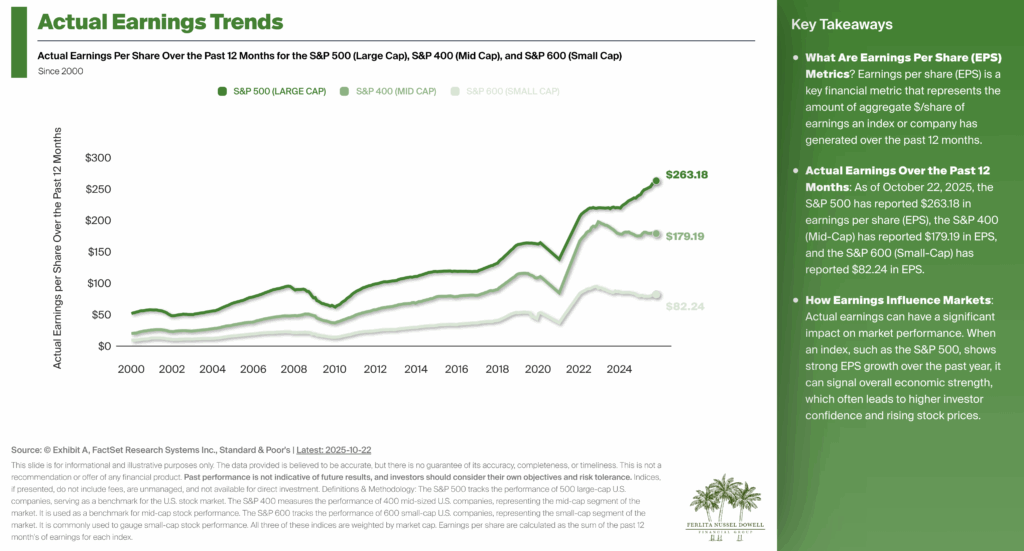
When investors talk about “earnings season,” they’re really talking about one of the most important forces behind stock prices: corporate profits. The chart above highlights how Earnings Per Share (EPS) has trended over the past year across small-, mid-, and large-cap companies — and understanding why those lines move the way they do can help you make sense of the markets.
1. Why Earnings Matter So Much
Earnings represent a company’s profitability — what’s left after subtracting expenses, taxes, and costs from revenue. The higher and more consistent those profits, the more valuable the business typically becomes.
When earnings rise, investors expect that future cash flows will grow too. That often leads to higher demand for shares and a rising stock price. Conversely, when earnings fall or fail to meet expectations, the market tends to revalue the company downward.
Think of it this way: if a business is steadily increasing profits, investors are usually willing to pay a higher price for each dollar of those profits (known as a higher price-to-earnings, or P/E, ratio).
2. The Role of Expectations
The stock market doesn’t just react to actual results — it reacts to expectations. A company might report strong earnings growth, but if Wall Street was expecting even stronger numbers, the stock can still drop.
That’s why you often see sharp price moves after quarterly reports: markets are constantly adjusting prices based on what’s expected next, not just what happened last quarter.
3. Comparing Small-, Mid-, and Large-Cap Trends
In the chart, we can see:
- Large-cap companies show steadier, slower-moving EPS growth — often because they’re established firms with diversified revenue streams.
- Mid-cap firms strike a balance: they can be more nimble than large caps but more stable than small caps.
- Small-cap stocks display more volatility in earnings — both higher potential upside in strong economic periods and sharper declines when conditions tighten.
This dynamic helps explain why small-cap stocks often outperform coming out of recessions (when earnings recover quickly), but can lag during periods of higher interest rates or slower growth.
4. Earnings and the Broader Economy
Corporate earnings are a mirror of the broader economy. Rising EPS typically coincides with economic expansion, strong consumer spending, and business investment. Declining EPS, on the other hand, can signal tightening credit, lower demand, or margin pressure from inflation.
That’s why investors watch earnings not only to evaluate individual companies but also to gauge the health of the economy as a whole.
5. What This Means for Investors
For long-term investors, the lesson is simple:
- Focus on quality companies with sustainable earnings growth.
- Be mindful of valuation — paying too much for earnings today can reduce future returns.
- Diversify across company sizes and sectors to capture different earnings cycles.
While the market’s day-to-day reactions can be unpredictable, over time, stock prices tend to follow earnings.
As the saying goes: “In the short run, the market is a voting machine; in the long run, it’s a weighing machine.” — Benjamin Graham